
Introduction
The retrospective applicability of statutes is one of the most debated doctrines in Indian jurisprudence. It raises fundamental questions about fairness, predictability, and the balance between legislative power and individual rights. At its core, the doctrine examines whether a law can govern events or transactions that occurred before its enactment. While the Indian legislature possesses the authority to enact retrospective laws, this power is subject to constitutional safeguards and judicial scrutiny.
Foundational Principle: Presumption Against Retrospectivity
Indian courts operate on the presumption that laws are prospective unless the legislature explicitly states otherwise. This principle ensures that individuals are judged by the law as it stood at the time of their actions. The Supreme Court in P. Mahendran v. State of Karnataka emphasized that statutes should not be given retrospective effect beyond what their language clearly mandates.
Constitutional Safeguards
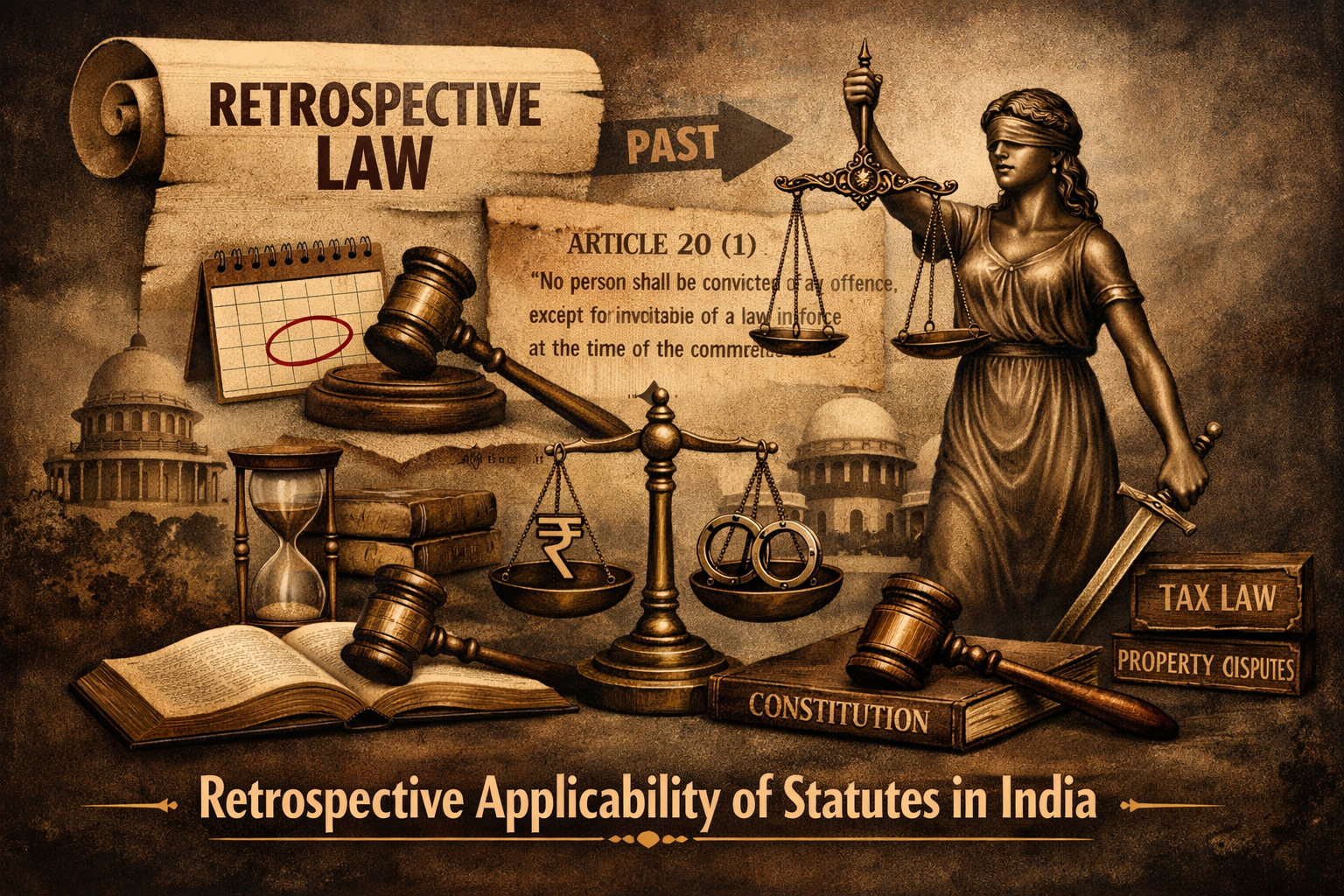
- Article 20(1): Provides an absolute bar against retrospective criminal legislation. No person can be punished for an act that was not an offense at the time it was committed.
- Civil Rights: Retrospective civil laws may be challenged if they violate Article 14 (equality before law), Article 19(1)(g) (freedom of trade/profession), or Article 300A (right to property).
- The judiciary has consistently balanced legislative competence with fundamental rights, as seen in B.S. Yadav v. State of Haryana.
Types of Retrospective Laws
- Retrospective vs. Retroactive: Retrospective laws attach new consequences to past acts, while retroactive laws impair vested rights.
- Clarificatory Amendments: Applied retrospectively to explain existing provisions (Shyam Sunder v. Ram Kumar).
- Curative Statutes: Correct legislative errors and validate prior actions.
Landmark Case Laws
- K.M. Nanavati v. State of Maharashtra (1961): Barred retrospective increase in criminal penalties.
- Vodafone International Holdings v. Union of India (2012): Sparked global debate on retrospective tax amendments and investor confidence.
- CIT v. Vatika Township (2015): Held that retrospective tax laws cannot impose fresh liabilities.
- KS Puttaswamy v. Union of India (2017): Reinforced limits on retrospective laws in light of evolving rights.
Limitations and Safeguards
- Protection of Vested Rights: Courts resist retrospective laws that strip individuals of rights already accrued.
- Reasonableness Test: Retrospective application must be rational, not arbitrary.
- Beneficial Legislation: Laws reducing penalties or conferring benefits may apply retrospectively (T. Barai v. Henry Ah Hoe).
- Taxation: Retrospective tax laws face stricter scrutiny due to their impact on economic stability.
Contemporary Contexts
- Tax Laws: The Vodafone controversy highlighted the chilling effect of retrospective taxation on foreign investment.
- Service Laws: Retrospective changes in promotions or pensions must withstand Article 14 scrutiny.
- Land Acquisition: Amendments affecting compensation often raise disputes over retrospective applicability.
Criticisms and Debates
- Unfairness: Retrospective laws undermine certainty and predictability.
- Investment Climate: Retrospective taxation damages India’s reputation as a stable investment destination.
- Judicial Overreach vs. Legislative Autonomy: Courts striking down retrospective laws sometimes face criticism for encroaching on legislative powers.
Conclusion
The doctrine of retrospective applicability in India reflects a delicate balance between legislative authority and constitutional fairness. While retrospective laws are permissible, they must be crafted with clarity, reasonableness, and respect for vested rights. Going forward, precise legislative drafting and consistent judicial interpretation are essential to ensure that retrospective laws serve the public interest without eroding trust in the legal system.